Remember that feeling of wanting to play a cool song on the piano, but feeling totally lost on where to begin? Maybe you’ve seen amazing pianists and dreamt of creating music yourself. Well, guess what? You absolutely can! This guide will help you discover how to learn how to play piano by yourself, even if you’ve never touched a key before. We’ll explore the steps, tricks, and resources that make learning accessible. You’ll gain practical advice to get started, avoiding common pitfalls, and building a foundation that makes learning fun and rewarding. Get ready to turn that dream into reality!
Getting Started With Your Piano Adventure
The first step is always the most exciting: deciding you want to do something! Before you even touch a key, there’s some groundwork to do. This involves getting the right equipment and preparing your learning space. It’s like gathering your tools before building a treehouse. Making this initial setup simple can set you up for success. We’ll examine the best types of instruments for beginners and look at some free and cheap resources to get started. By starting in the proper manner, you can ensure a smoother and more enjoyable experience as you begin your musical adventure.
Choosing Your Instrument
The right piano is crucial. You have a few options, each with pros and cons, but you don’t need a concert grand to begin. The most important thing is that your instrument feels comfortable and inspires you. A good instrument helps create a welcoming environment for your learning.
- Acoustic Piano: A traditional choice, providing a rich, full sound. Acoustic pianos come in different sizes, including upright and grand. An upright piano will be more affordable and appropriate for a beginner. However, acoustic pianos require tuning and periodic maintenance. They take up a lot of space and can be noisy.
- Digital Piano: Digital pianos simulate the sound and feel of acoustic pianos, often with weighted keys that feel like a real piano. They offer several advantages, including volume control (perfect for late-night practice), built-in sounds, and the ability to connect headphones. They also need less maintenance.
- Keyboard: A keyboard is a more affordable option, and the best way to get started. Keyboards usually have fewer keys than a full piano, and the keys are often not weighted. They can be a perfect beginning point.
Finding a quality used acoustic piano can be a great way to save money. Be certain to have it inspected by a professional before purchasing to assess any possible damage or repair costs.
Digital pianos can be less expensive and more portable than acoustic pianos. They also allow you to practice without disturbing others. Many have helpful features like metronomes and even pre-programmed songs to learn.
Keyboards are very portable and can be a good choice if you’re uncertain about how dedicated you’ll be. Consider keyboards with at least 61 keys (five octaves) to give you a decent range to play in. These are lightweight, and typically offer built-in sounds and features at a lower cost.
Setting Up Your Practice Space
Your practice space should be free of distractions. A dedicated, comfortable space makes practice more enjoyable and creates a habit of practice. This setup will include physical space considerations like lighting, seating, and placement of your instrument, plus software considerations for your device setup.
- Location: Choose a quiet area. Try to minimize distractions. This allows you to focus without getting sidetracked. Your spot does not need to be fancy; a quiet corner works perfectly.
- Lighting: Good lighting is very important. Adequate lighting will help you see the notes clearly. Having enough light keeps you from straining your eyes.
- Seating: Get a good chair. The correct posture is essential. Sit upright with your back straight and your feet flat on the floor. Proper posture makes playing easier and prevents physical issues.
Try to locate your instrument away from high-traffic areas in your home. This helps to reduce background noise and minimize interruptions during your practice.
Natural light is best, but a good lamp can be helpful if you are practicing at night or if your practice area lacks natural light. Ensure the light shines on the sheet music without creating glare.
Adjust your piano bench or chair to ensure your elbows are at the same level as the keys. This is good for comfortable playing. Some digital pianos have adjustable stands that help with this.
The Basics: Understanding Notes and Keyboards
Before you play actual songs, you need to learn the basic vocabulary of music. This means understanding notes, the musical alphabet, and the layout of the piano keyboard. It’s like learning the letters of the alphabet before reading a book. The keyboard layout and musical notation might look like code at first, but with a bit of effort, it’ll begin to make sense, and you’ll be on your way to playing songs. Once you master the basics, it becomes much easier to explore more complex aspects of music.
The Musical Alphabet and Keyboard Layout
The piano keyboard mirrors the musical alphabet, which helps to learn the location of notes. The more familiar you are with these fundamentals, the quicker you will progress. It is useful to understand that the piano is arranged with repeating patterns of black and white keys. This pattern will help you easily find any note on the keyboard.
- The Musical Alphabet: The musical alphabet consists of seven letters: A, B, C, D, E, F, and G. After G, it starts over at A. These letters represent the white keys on the piano.
- Locating Middle C: Middle C is a crucial landmark. It’s a key to finding your way around the keyboard. It is the C nearest the middle of the piano, and you can locate it by finding the group of two black keys.
- Octaves: An octave is a set of eight notes. The same note, but higher or lower in pitch, is an octave away. Understanding octaves helps to read music more efficiently.
The black keys are arranged in groups of two and three. These patterns help you find your bearings. The lettered notes are the white keys, and the black keys are called sharps (#) and flats (♭), representing the notes in between.
Middle C helps establish the position of your hands. Once you know Middle C, you can easily find other notes. It serves as a home base for many exercises and songs.
Once you know one C, you can find all the other Cs on the keyboard, each an octave apart. Recognizing octaves will let you quickly move up and down the keyboard.
Reading Sheet Music
Sheet music is like a map for playing the piano. Learning to read music is an important part of how to learn how to play piano by yourself. The staff, clefs, and notes will seem confusing at first, but with time, they become second nature. It takes effort and commitment to read music, but the skills you gain will give you access to a huge library of songs.
- The Staff and Clefs: Music is written on a staff, which is a set of five lines and four spaces. The treble clef (often used for the right hand) and the bass clef (for the left hand) show the pitch of the notes.
- Note Values: Notes have different values (whole notes, half notes, quarter notes, etc.), which determine their duration. Understanding note values helps to get the rhythm right.
- Key Signatures and Time Signatures: Key signatures tell you which sharps or flats are used in a piece of music. The time signature tells you how many beats are in a measure and what kind of note gets one beat.
The treble clef often has the G clef symbol, and the bass clef has the F clef symbol. The placement of a note on the staff tells you which note to play on the piano.
A whole note lasts for four beats, a half note for two beats, and a quarter note for one beat. Rhythm is critical in music, and you need to get the duration of these notes correct.
The key signature is at the beginning of the music, after the clef. Time signatures are also there at the beginning. Recognizing and understanding these symbols will make reading music far simpler.
Developing Playing Skills and Techniques
Once you understand the basic components, it is time to build playing skills and techniques. This step moves beyond theory and into practice. This is where you learn how to make music with your hands. Developing proper finger techniques and playing with good rhythm are essential. This will improve your musicality, making music more enjoyable for you and anyone who might be listening.
Hand Positioning and Posture
Proper posture and hand position are important for playing piano. Bad habits can lead to problems. Good form makes it easier to play and helps avoid injury. You need to focus on sitting correctly, the right hand shape, and using the correct fingers for each note. These are the building blocks of good technique.
- Sitting Position: Sit upright with your back straight and your feet flat on the floor. Your arms should be relaxed, with your elbows slightly away from your body.
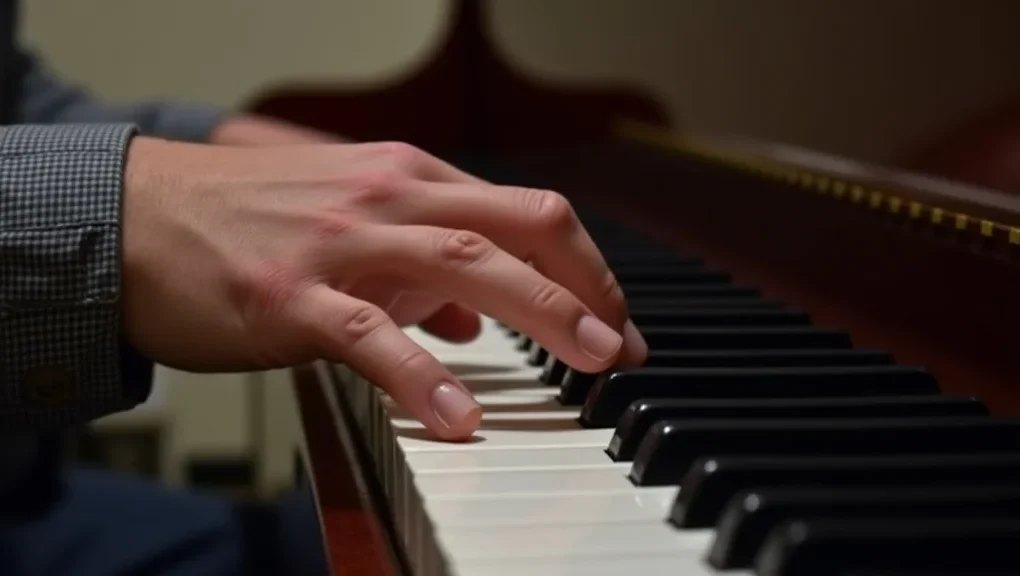
- Hand Shape: Your hands should be curved, like holding a small ball. Keep your wrists relaxed and level. Your fingers should curve, with the tips hitting the keys.
- Finger Exercises: Regular finger exercises help improve dexterity and strength. These exercises involve playing scales, arpeggios, and other patterns to train your fingers.
The piano bench or chair should be adjusted so your elbows are level with the keyboard. This allows your arms and shoulders to be relaxed. A good posture is important to avoid strain.
Avoid a flat or stiff hand position. A curved hand helps with control and evenness. Curved hands also provide more strength and control.
Practice these exercises with a metronome for consistent timing. This will help build muscle memory and coordination. Playing these exercises with a variety of rhythms is a great practice technique.
Rhythm and Timing
Good rhythm is the backbone of any music. Timing is the foundation of music. Learning about rhythm involves understanding how long notes last and playing them consistently. When you learn how to play the correct timing, this is what gives music its pulse. You also need to get familiar with a metronome and start practicing with one. This will help you keep a steady beat.
- Using a Metronome: A metronome is a device that provides a steady beat. Practicing with a metronome will improve your timing. This tool is very important for learning.
- Counting Rhythms: Learn to count the beat and subdivide notes. This includes counting quarter notes, eighth notes, and sixteenth notes. It helps you keep track of where you are in the music.
- Practice with Different Rhythms: Experiment with playing different rhythms, like dotted notes and syncopation. These rhythms add variety to the music. Experimentation keeps your practice interesting.
Start with a slow tempo and gradually increase the speed. Using a metronome helps you play in time and develop your rhythmic skills. You can find free metronome apps to use.
Practice counting out loud while you play. This will help you develop your internal sense of rhythm. Counting accurately is necessary for performing songs.
Try playing simple rhythmic patterns with your hands before adding notes. This will help improve your overall rhythmic understanding. This is another fun way to stay engaged.
Resources and Tools for Self-Learning
Numerous resources can support your quest on how to learn how to play piano by yourself. These are online tutorials, apps, and books. This is a very common way to learn. They will guide you through the basics. You will get to the point of playing more complex pieces. The available resources help you gain knowledge, stay motivated, and get feedback on your playing.
Online Tutorials and Video Lessons
Online tutorials and video lessons are useful tools to guide you. Video lessons offer visual aids that can be very helpful. Free content can assist you in learning. You have many options available to you.
- YouTube Channels: Numerous YouTube channels provide piano lessons, tutorials, and performances. This is a good way to get started. Many channels offer free content.
- Websites and Online Courses: Websites offer structured courses with lessons, exercises, and feedback. This will give you structure. This is a very structured way to learn piano.
- Interactive Software: Interactive software provides real-time feedback as you play. This can help with rhythm and notes. This is an exciting way to learn.
Look for channels that suit your learning style. Some channels focus on beginners, and others provide more advanced content. Search for “piano lessons for beginners” or “learn piano online.”
These sites can offer graded lessons. Look for sites that include interactive exercises and progress tracking. Some popular options include flowkey, Skoove, and Simply Piano.
These apps listen to you play through your device’s microphone and provide guidance. They can help you with mistakes. Some options include Yousician and Piano Marvel.
Apps and Software
Apps and software are designed for various levels. They provide interactive lessons, practice tools, and gamified learning experiences. These apps can make learning fun and engaging, which is important. They often offer a range of features. These features will assist you in your practice journey.
- Piano Learning Apps: Apps like Simply Piano, flowkey, and Skoove offer interactive lessons and feedback. They have lessons for all levels. They give you the tools you need to progress.
- Metronome Apps: Metronome apps are essential for developing rhythm. They provide a steady beat. They keep your timing consistent during practice.
- Sheet Music Apps: Sheet music apps help you access sheet music. They also can include interactive features. They provide access to music when you want it.
These apps often track your progress and provide personalized lessons. You can practice with songs you love. These apps are designed to be user-friendly.
These apps come with different tempos. Many have features such as different beat patterns. Choose an app with adjustable settings and clear visual cues.
Apps like MuseScore and Musicnotes offer vast libraries of sheet music. They will make it easy to find and practice songs. Some apps let you transpose music to suit your skill level.
Progressing Your Skills
As you gain skills, you can advance and try more complex tasks. This means learning to play different genres and working on more challenging pieces. This can involve expanding your repertoire and building more advanced techniques. This level is essential for any pianist, from beginner to advanced. This journey is where you truly develop your skills.
Expanding Your Repertoire
The word “repertoire” refers to a list of songs you know how to play. Broadening your repertoire is key to enjoying music. This means practicing songs in different styles. This will not only make playing more fun, but also help you develop as a pianist.
- Choosing Songs: Choose songs you enjoy. This will keep you motivated. Try a variety of musical styles.
- Learning Different Genres: Explore genres like classical, pop, jazz, and blues. This will broaden your musical horizons. You will develop a wider set of musical skills.
- Practicing Regularly: Consistent practice is essential for improvement. Set a practice schedule and stick to it. This will make steady progress.
Start with simple pieces. Gradually increase the difficulty. Listening to the song beforehand can help. Picking songs you like is the key to progress.
Each genre introduces unique techniques and styles. This experience will expand your musical knowledge. Try to find music that excites you.
Even short, regular practice sessions are more effective. Aim for daily practice, even if it’s only for a few minutes. Regular practice will boost progress.
Improving Technique and Musicality
Developing technique and musicality goes hand-in-hand. This means honing your finger skills. This means adding expression to your playing. A combination of the two will make you a well-rounded musician. This is where you transform from a player to an artist. This transformation is rewarding.
- Scales and Arpeggios: Regular practice of scales and arpeggios is essential for finger dexterity. These exercises build strength and coordination. They will give you skills to play any song.
- Dynamics and Expression: Learning to control dynamics is vital. This will make your playing more interesting. Add variations to how loud or soft you play.
- Sight-Reading: Sight-reading is the skill of playing music you have never seen before. It is a very helpful skill. This expands your musical abilities.
Practice scales in all keys and at different tempos. Learn the patterns of arpeggios. This helps to improve hand coordination. This helps to master any song.
Practice playing with different volumes. Experiment with crescendos (gradually getting louder) and diminuendos (gradually getting softer). This will add emotion to your music.
Practice sight-reading with simple pieces. Try to read ahead of where you are playing. Sight-reading is a useful skill. This will enable you to play many songs.
Frequently Asked Questions
Question: How often should I practice when learning how to learn how to play piano by yourself?
Answer: Aim for at least 15-30 minutes of practice each day, even if it’s just a quick session. Regular, consistent practice is more effective than sporadic longer sessions. Even a few minutes a day is more helpful than practicing an hour only once a week. Consistency will build a solid foundation.
Question: How long does it usually take to learn to play the piano?
Answer: It depends on your goals and how much time you dedicate. You can learn basic chords and simple songs within a few months, and play more complex pieces after a year or two of consistent practice. Progress will vary based on your practice habits and natural talent.
Question: Should I take lessons from a teacher or try to learn by myself?
Answer: Both are possible! Learning by yourself is definitely doable, especially with the resources available today. If you have the discipline and enjoy self-teaching, go for it. A teacher can provide structured lessons, personalized feedback, and help prevent bad habits from forming, which helps to avoid pitfalls. Combine both ways!
Question: What are the most important things to focus on when first learning?
Answer: Focus on these three key elements: proper hand posture and finger technique, understanding music notes and rhythms, and, most importantly, enjoying the process! Start with the basics and building a strong foundation. This creates a good experience with music. It is essential to enjoy the process.
Question: What’s the best way to stay motivated when learning piano?
Answer: Set achievable goals, celebrate your progress, and choose music you love to play. The best way to stay motivated is to enjoy the journey. Practice with music you like. Join a piano community online to interact with other players, or find a buddy to learn with. The key is to keep it fun and rewarding.
Final Thoughts
You now have a solid foundation and direction on how to learn how to play piano by yourself. Remember, starting is the hardest part, but once you begin, the journey will take you far. By choosing the right instrument, setting up a good practice spot, and understanding the basics of music, you have already taken the first steps. The key is consistency. Make practice a habit and use the vast resources available to you. Celebrate your wins, big or small, and remember that music should be a source of joy. Keep practicing, explore different styles, and find what inspires you. Don’t be afraid to experiment, learn from your mistakes, and most importantly, have fun creating music! The piano world is waiting for you.