Remember that time you heard a song and thought, “Wow, I wish I could do that?” Well, maybe you were thinking about playing the piano! Perhaps you’re seeing friends or family playing and want to try, or maybe you just like the way it sounds. This guide is for you! We’re going to explore how to play piano for beginner, breaking down everything from the basics to getting you started playing simple tunes. You’ll learn the fundamentals and begin playing quickly, gaining the skills and confidence to begin your musical adventure. You’ll gain a solid foundation, which improves your Time on Page, and reduce your Bounce Rate, helping you become a pianist.
Getting Started with Piano Basics
Before you start making beautiful music, you need to know the basic structure of the piano. This includes understanding the layout of the keys, how they relate to musical notes, and how to sit properly. Think of it like learning the alphabet before reading a book. The piano, also known as a keyboard, has a simple repeating pattern of black and white keys, but it is a fun instrument to start on! Don’t worry, the layout might seem complicated at first, but it quickly becomes second nature. Learning how to play piano for beginner isn’t as difficult as it seems, and it can be a lot of fun.
Understanding the Keys
The piano keyboard consists of white keys and black keys. The white keys are the notes of the musical alphabet: A, B, C, D, E, F, and G. They are arranged in a repeating pattern. The black keys are grouped in sets of two and three. These black keys represent sharps and flats, which change the sound of the notes. Once you understand this pattern, you’ll be able to find any note on the keyboard. Practice identifying the notes on the keyboard, and you will have a foundation to quickly start playing songs. Remember, practice makes perfect!
- White Keys: The white keys represent the natural notes of the musical scale (A, B, C, D, E, F, and G). Each white key has a specific name.
- Black Keys: The black keys are arranged in groups of two and three. They represent sharps and flats, which are the notes between the white keys.
- Octaves: The pattern of white and black keys repeats itself across the keyboard in units called octaves. An octave is a set of eight notes. Understanding octaves helps you find the same notes in different positions on the keyboard.
- Finding ‘C’: A helpful tip is to look for the groups of two black keys. The white key directly to the left of the two black keys is always ‘C’.
Proper Posture and Hand Position
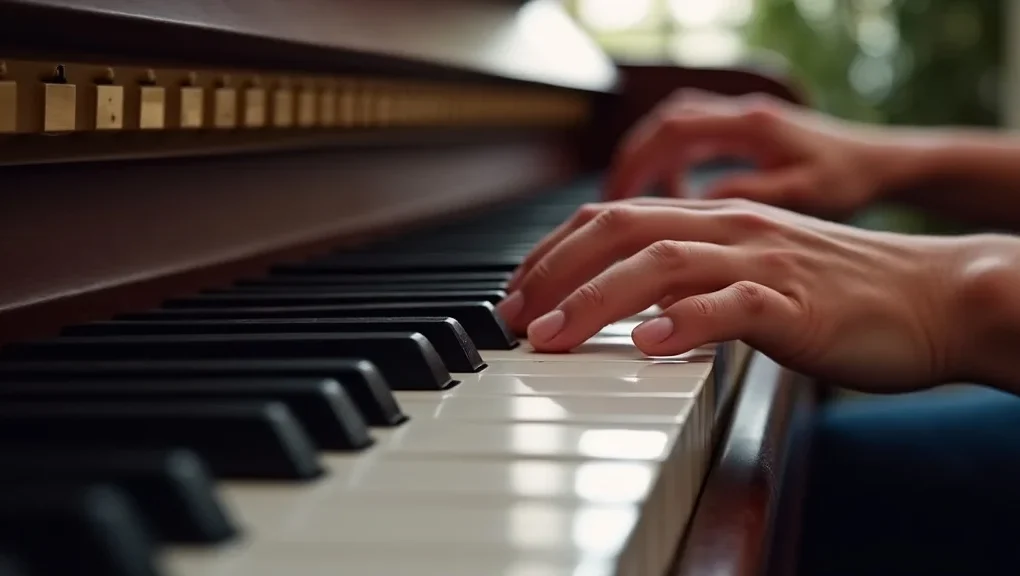
Good posture is very important when playing the piano. It helps you play comfortably and prevents injuries. Sit up straight on the piano bench with your feet flat on the floor. Your arms should be relaxed, with your elbows slightly away from your body. Your wrists should be flexible, and your fingers should be curved as if you’re holding a small ball. This position allows for the most efficient and comfortable playing. Being comfortable is very important when you learn how to play piano for beginner!
- Sit Up Straight: Make sure your back is straight and your shoulders are relaxed. Avoid slouching.
- Feet Flat on the Floor: Place your feet flat on the floor or a footrest.
- Elbows Relaxed: Keep your elbows slightly away from your body.
- Curved Fingers: Imagine holding a small ball in your hands. Curve your fingers like this, keeping your knuckles high.
- Relaxed Wrists: Keep your wrists flexible, not stiff.
Learning to Read Music
Reading music might seem like a whole new language, but it’s not as hard as it looks! Music notation is a system of symbols that tell you which notes to play, for how long, and when to play them. Learning to read music opens up a world of musical possibilities. You’ll be able to play songs written by any composer, not just those you can find online. Music reading is the cornerstone of the experience of how to play piano for beginner. Let’s explore some basic elements.
The Staff, Clefs, and Notes
Music is written on a staff, which is made up of five lines and four spaces. Notes are placed on these lines and spaces to represent different pitches (highness or lowness of a sound). The clef symbol, usually the treble clef (for higher notes) or the bass clef (for lower notes), tells you which notes are on the staff. Notes can be written with stems pointing up or down.
- The Staff: The staff is a set of five lines and four spaces where notes are written.
- The Treble Clef: This clef is used for higher notes. It looks like a stylized ‘G’.
- The Bass Clef: This clef is used for lower notes. It looks like a backward ‘C’ with two dots.
- Notes: Notes are oval shapes placed on the lines or in the spaces of the staff. Their position indicates the pitch.
Note Values and Rhythms
Notes have different durations, or lengths. These are represented by different symbols. A whole note lasts for four beats, a half note for two beats, a quarter note for one beat, and so on. Understanding note values is important for playing music with the correct rhythm. Learning about rhythm helps you keep the beat and play the music as it’s written. Practice counting out these different note values to understand the concepts.
- Whole Note: A whole note gets four beats.
- Half Note: A half note gets two beats.
- Quarter Note: A quarter note gets one beat.
- Eighth Note: An eighth note gets half a beat.
- Rests: Rests are symbols that indicate silence for a certain duration.
Playing Simple Chords and Scales
Once you’ve got the basics down, it’s time to start playing! Learning some simple chords and scales will quickly build your ability to make music. Chords are combinations of notes played together, while scales are a sequence of notes. Practice both, and you will begin to play songs right away. This is one of the fun parts of how to play piano for beginner, and soon you’ll be playing!
Basic Chords: C, G, and F
Start with the chords C, G, and F. These are some of the easiest chords to learn, and they appear in many popular songs. Each chord is made up of three notes. For example, the C chord consists of C, E, and G. Practice playing these chords with your left hand, your right hand, and then both hands together. You’ll be able to accompany yourself and start playing many songs.
- C Major Chord: C, E, G
- G Major Chord: G, B, D
- F Major Chord: F, A, C
- Practice: Practice playing these chords with your right hand, your left hand, and then both hands together.
- Experiment: Try playing different combinations of these chords.
Major and Minor Scales
Scales are a sequence of notes that follow a specific pattern. The most common are major and minor scales. Learning scales helps you develop finger dexterity and musical skill. Practice the C major scale, which consists of all the white keys from C to C. Also, learn the A minor scale. Practicing scales regularly will improve your finger strength and coordination. Try playing them in different octaves.
- C Major Scale: C-D-E-F-G-A-B-C
- A Minor Scale: A-B-C-D-E-F-G-A
- Practice: Practice playing these scales slowly and evenly.
- Fingerings: Use proper fingerings to help with your dexterity.
- Expand: After practicing these scales, you can learn other scales.
Practicing and Developing Skills
Consistent practice is the key to improving your piano skills. Even short, regular practice sessions are better than long, sporadic ones. Set a practice schedule that you can stick to. Be patient and enjoy the process. There will be times when you get frustrated, but don’t give up! Every time you practice, you get better. This is the process for how to play piano for beginner.
Setting a Practice Schedule
Consistency is key to making progress. Set a regular time each day or week for your practice. Even 15-30 minutes of practice each day can make a big difference. Break your practice time into smaller chunks, focusing on different aspects of your playing, such as scales, chords, and songs. Don’t worry if you don’t play perfectly. Focus on gradually getting better.
- Set Specific Times: Schedule your practice sessions as if they were appointments.
- Start Small: Begin with short practice sessions and gradually increase the time.
- Be Consistent: Practice regularly, even if it’s just for a short time each day.
- Break It Up: Divide your practice into sections: scales, chords, songs.
Tips for Effective Practice
There are a few tricks you can use to make your practice time more effective. Warm up your fingers with scales and simple exercises. Break down difficult pieces into smaller sections, and practice each section slowly before gradually increasing the tempo. Don’t be afraid to make mistakes. Learning from them is part of the process. Remember, learning how to play piano for beginner is a journey!
- Warm-Up: Begin with scales and finger exercises to warm up your hands.
- Slow Practice: Practice new pieces slowly at first.
- Section Practice: Break difficult pieces into smaller sections.
- Record Yourself: Record yourself playing to identify areas for improvement.
Here’s a comparison to illustrate the benefits of regular practice:
| Practice Schedule | Results |
|---|---|
| 30 minutes/day, 5 days/week | Rapid progress, consistent skill development |
| 2 hours/week, all at once | Slower progress, possible plateaus |
| Sporadic practice | Little or no progress, skills may decline |
Choosing a Piano or Keyboard
You have to have an instrument before you start learning! There are different types of pianos and keyboards you can use. Each has its own benefits and drawbacks. Consider your budget, space, and the type of music you want to play when choosing an instrument. While a grand piano might be the dream, a digital keyboard is a great place to start, especially if you’re a beginner. Learn about your options for how to play piano for beginner.
Acoustic vs. Digital Pianos
Acoustic pianos are traditional pianos that use hammers and strings to produce sound. Digital pianos simulate the sound and feel of an acoustic piano, but they use electronic technology. Acoustic pianos produce a richer sound, but they are expensive, require regular tuning, and take up a lot of space. Digital pianos are more affordable, portable, and maintenance-free, but they may not replicate the feel and sound of an acoustic piano.
- Acoustic Pianos:
- Rich, authentic sound.
- Requires tuning.
- Takes up more space.
- Expensive.
- Digital Pianos:
- Affordable.
- Portable.
- No tuning required.
- Can simulate the sound of an acoustic piano.
Considering Key Features
Whether you choose an acoustic or digital piano, look for certain key features. For a beginner, a full-sized keyboard with 88 keys is ideal. Weighted keys, which simulate the feel of an acoustic piano, are also helpful. A good sound system is important for a digital piano. Other features to consider are a sustain pedal, a metronome, and a variety of built-in sounds. These options make learning how to play piano for beginner a better experience!
- 88 Keys: A full-sized keyboard is the standard.
- Weighted Keys: They replicate the feel of an acoustic piano.
- Sound Quality: Good speakers or headphones make practice more enjoyable.
- Sustain Pedal: Important for sustaining notes.
- Metronome: Helps you keep time.
Learning Resources and Tips
There are many resources available to help you learn the piano. Consider taking lessons from a music teacher. You can also find numerous online tutorials and apps that can guide your progress. Don’t hesitate to seek out resources. Learning is the fun part of how to play piano for beginner! Here are some resources to get you started.
Finding a Music Teacher
A good music teacher can provide personalized instruction and feedback. They can help you develop good habits and avoid bad ones. Find a teacher who is experienced, patient, and can work with your learning style. Lessons can be a rewarding way to improve your musical skill. They can give you encouragement and answer your questions. Music teachers can give you feedback to make sure you’re on track!
- Find Qualified Teachers: Look for teachers with experience and good reviews.
- Ask About Their Style: Choose a teacher who matches your learning style.
- Start with a Trial Lesson: See if you and the teacher are a good fit.
Online Resources and Apps
Many online resources and apps can supplement your learning. There are websites and YouTube channels that provide lessons and tutorials. Apps offer interactive exercises and games. These resources are convenient and affordable. Use these materials to expand your understanding. They can give you more practice options. You can use these to help you master how to play piano for beginner.
- YouTube Channels: Search for channels with piano tutorials.
- Websites: Check out online learning platforms.
- Apps: Explore apps that offer interactive lessons and exercises.
- Sheet Music: Find websites to download sheet music for free.
Scenario:
- First Practice Session: Start by familiarizing yourself with the keyboard layout. Locate middle C, and find the pattern of black keys. Then, practice playing scales for 15 minutes. Finish with some basic chord exercises for 10 minutes.
- Intermediate Practice Session: Once you are confident, find sheet music for a beginner song. Practice playing the song slowly. Practice playing the notes with correct rhythm for 20 minutes. Then, increase the tempo. Finally, try to play the song with both hands.
Frequently Asked Questions
Question: What’s the best age to start learning piano?
Answer: There is no single “best” age! You can learn at any age, as long as you’re interested and willing to practice. Younger children often benefit from a playful approach, while older learners can focus on more structured methods.
Question: How often should I practice?
Answer: Consistency is key! Aim for at least 15-30 minutes of practice most days of the week. Even short, regular sessions are more effective than infrequent, long ones.
Question: Should I take lessons or teach myself?
Answer: Both are possible! Lessons offer personalized guidance and feedback. Self-teaching is doable with online resources. Consider a combination: lessons for the basics, and online resources for supplemental practice.
Question: What’s the easiest song to learn on the piano?
Answer: Many beginner-friendly songs use simple chords and a few basic notes. “Hot Cross Buns” and “Mary Had a Little Lamb” are popular examples, but search online for “easy piano songs” for a variety of options.
Question: What if I don’t have a piano?
Answer: A digital keyboard is a great alternative to an acoustic piano. You can find affordable models that have weighted keys and many features. They are great if you are learning how to play piano for beginner.
Final Thoughts
Learning how to play piano for beginner is an enriching and rewarding experience that can bring joy for years to come. Start by understanding the piano’s layout and familiarize yourself with the basics of reading music. Mastering simple chords and scales creates a foundation for playing many songs. Commit to consistent practice, even if it’s just for a short time each day. Explore learning resources, like a music teacher or online lessons, to guide your progress. Choose an instrument that fits your needs and budget. Remember, the most important thing is to enjoy the process and to be patient with yourself! Each practice session, each correctly played note, is a step forward. You got this!