Remember that time you heard a beautiful piano melody and wished you could play? Maybe you’ve always dreamed of creating your own music. Well, learning how to learn to play the piano doesn’t have to be a distant fantasy! This guide breaks down the process, making it approachable and fun. You’ll discover the essential steps, from reading music to practicing effectively. By the end, you’ll have a clear roadmap to start your musical adventure and gain the knowledge needed to begin playing. This will allow you to quickly start your journey to how to learn to play the piano and give you the tools you need to succeed.
Getting Started with the Piano: Equipment and Basics
Before you play, you need the right tools and a solid foundation. This section covers the essential equipment, such as a piano or keyboard, and introduces fundamental concepts like the layout of the keys, how to sit properly, and the initial notes. Knowing these basics will make your learning much smoother and less overwhelming. It is important to begin with the right approach and setup to support your learning process. This will set you on the correct path when beginning your training to play.
Choosing Your Instrument
The first step is selecting your instrument. You have several choices: acoustic pianos, digital pianos, and keyboards. Acoustic pianos offer the most authentic feel and sound but are the most expensive and require tuning. Digital pianos replicate the acoustic piano experience, often with weighted keys, and offer the convenience of headphone jacks and various sounds. Keyboards are generally more affordable, lighter, and portable but often have unweighted keys, which may be less responsive. The decision hinges on your budget, space availability, and desired features. Consider what kind of piano will best suit your needs. Do you want something portable or more permanent? Will you be playing with headphones? These are all factors that should affect your ultimate decision.
- Acoustic Pianos: These are the traditional instruments. They produce sound through hammers striking strings. They deliver the most authentic playing experience due to their weighted keys. These pianos require tuning and regular maintenance. Consider the space requirements and cost when choosing an acoustic piano.
- Digital Pianos: These instruments simulate acoustic pianos. They offer weighted keys and a range of sounds. They’re often less expensive and don’t need tuning. Digital pianos are a good choice if you’re concerned with noise since they generally have a headphone jack.
- Keyboards: These are more affordable and portable options. They have unweighted keys and a wide variety of sounds. They are excellent for beginners. Keyboards, with a simple design, are perfect for exploring various sounds, from pianos to synthesizers.
Understanding the Keyboard Layout
The keyboard’s layout seems complex at first, but with a little practice, it quickly becomes intuitive. The white keys represent the natural notes (A, B, C, D, E, F, G), repeating in octaves. The black keys are arranged in groups of two and three, representing sharps and flats. Locate the “C” notes. Usually, it’s just to the left of the two black keys. Knowing this pattern will help you find any note on the keyboard. Take a look at the layout and get familiar with it before you even begin to practice. Doing so will help increase your familiarity with the piano.
- White Keys: These represent the natural notes in the musical alphabet: A, B, C, D, E, F, and G. They are arranged in a repeating pattern. This pattern allows for recognizing octaves, which are the same notes but at different pitches.
- Black Keys: These keys represent sharps (#) and flats (♭), notes that are a half-step higher or lower than the natural notes. They are grouped in twos and threes. These groups offer visual reference points, which allows you to find notes quickly and accurately.
- Octaves: An octave is a set of eight notes where the last note has double the frequency of the first. Every C on the piano, for example, is the same note, but it is in a different octave. This means that a pianist can play in different registers, which creates a rich, full sound.
Proper Posture and Hand Position
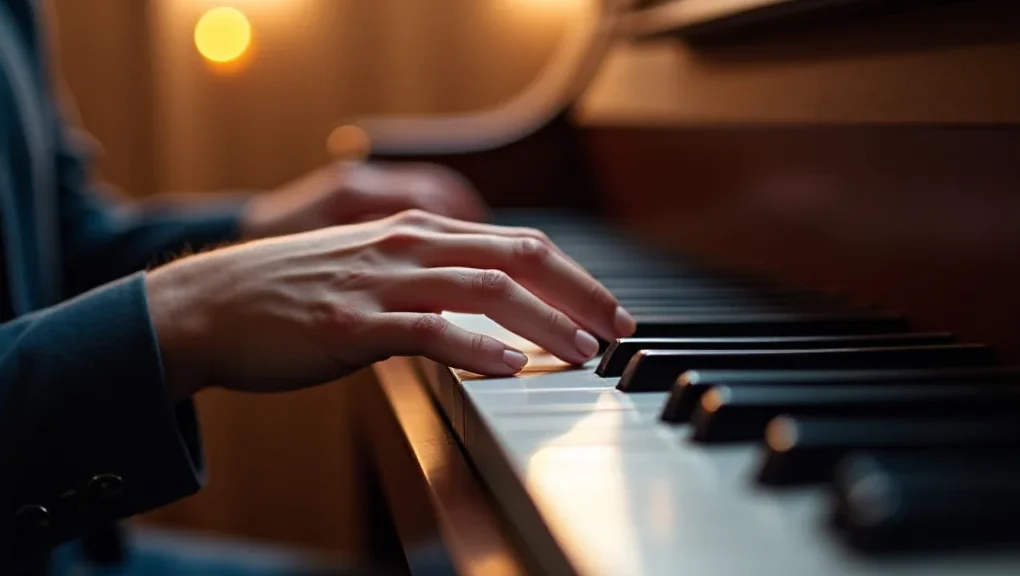
Posture and hand position are important for comfort and injury prevention. Sit up straight at the piano bench with your feet flat on the floor or on a footrest. Your arms should be relaxed, with your elbows slightly away from your body. Curve your fingers, as if you’re holding a small ball, and place them on the keys. Maintaining the right posture is key to making sure you stay comfortable and injury-free. Learning the proper posture and hand positions will allow you to play for a long time.
- Sitting Position: Sit upright with your back straight, but not stiff. Your feet should rest flat on the floor or on a footrest. Ensure the bench is at a comfortable height. Having a good seat ensures that you are in a comfortable position and helps prevent physical strain.
- Hand Position: Curve your fingers naturally, as if holding a ball. Keep your wrists relaxed and level with the keys. Avoid stiff wrists. This natural curve and relaxed posture allows for smoother movements.
- Arm Position: Your arms should be relaxed at your sides. Your elbows should be slightly away from your body. Avoid tense shoulders. This relaxed positioning helps in preventing any issues and allows you to practice more comfortably.
Music Theory Fundamentals for Piano Beginners
Understanding basic music theory is critical for playing the piano. This section explains essential concepts like notes, scales, chords, and rhythm. Knowing these elements will not only enable you to read and play music but also help you develop a deeper understanding of music. You’ll gain the building blocks of music literacy. This section will guide you through the process of developing a solid base for all future learning to learn to play the piano.
Reading Music: Notes, Staff, and Clefs
Music is written on a staff, which consists of five horizontal lines. Notes are placed on these lines or in the spaces between them, indicating their pitch. The treble clef is used for higher-pitched notes, while the bass clef is used for lower-pitched notes. Learn where the notes are located on the staff and relate them to the piano keys. You will also learn the basics of notes and how to read them. It takes practice, but it’s like learning another language. Reading notes is key for your musical endeavors.
- The Staff: Music notation is written on a staff, which consists of five horizontal lines and four spaces. Each line and space represents a specific note, indicating the pitch. Understanding the layout of the staff is essential.
- Treble Clef: The treble clef, also known as the G clef, is used for higher-pitched notes. The notes on the lines, from bottom to top, are E, G, B, D, and F. The spaces, from bottom to top, are F, A, C, and E. It is essential to use a treble clef to help read your music better.
- Bass Clef: The bass clef, also known as the F clef, is used for lower-pitched notes. The lines, from bottom to top, are G, B, D, F, and A. The spaces, from bottom to top, are A, C, E, and G. Make sure you understand how the bass clef works to better interpret notes.
Understanding Rhythm and Time Signatures
Rhythm is a critical aspect of music. Notes have different durations, such as whole notes, half notes, quarter notes, and eighth notes, each representing a specific amount of time. Time signatures, found at the beginning of a piece, show how many beats are in each measure and what type of note gets one beat. Practicing with a metronome will help you develop a solid sense of rhythm. Knowing the basics of rhythm will help you to play music with the correct timing and create a more professional sound.
- Note Values: Notes have different durations. A whole note lasts for four beats, a half note for two beats, a quarter note for one beat, and an eighth note for half a beat. This allows for the creation of rhythm.
- Time Signatures: Time signatures indicate how many beats are in each measure. The top number indicates the number of beats per measure, and the bottom number indicates the note value that receives one beat. This helps you to manage the timing of your music.
- Metronome: A metronome helps keep a consistent tempo. Practicing with a metronome is essential to developing a good sense of rhythm and timing. Using a metronome ensures that you can learn a piece of music properly and play it in time.
Scales and Chords: Building Blocks of Music
Scales are a sequence of notes arranged in a specific order. Major scales have a bright, cheerful sound, while minor scales have a sadder sound. Chords are formed by playing three or more notes together. Learning basic scales and chords gives you a foundation for understanding melody and harmony. These elements are the building blocks of almost all music you hear. Familiarizing yourself with scales and chords will help you to create more complex compositions.
- Major Scales: Major scales have a specific pattern of whole steps and half steps, giving them a cheerful sound. Learning major scales helps you understand the construction of melodies. Try learning a few major scales to help expand your playing ability.
- Minor Scales: Minor scales also follow a specific pattern, resulting in a sadder sound. There are different types of minor scales (natural, harmonic, and melodic). Learning the different minor scales will add more diversity to your ability.
- Chords: Chords are formed by playing multiple notes together. Basic chords like major, minor, and seventh chords are common. Learning how to create chords will greatly expand your playing ability and help to develop your song-writing skills.
Effective Practice Techniques for Playing the Piano
Practicing is key to progress in your piano studies. This section covers effective practice techniques, including setting goals, breaking down pieces, using a metronome, and developing good habits. It will teach you how to organize your practice time and practice efficiently to maximize your learning. This is a very important part of how to learn to play the piano, as your daily habits are key to success.
Setting Realistic Goals and Practice Schedules
Setting clear and realistic goals will give you direction and keep you motivated. Start with short-term, achievable goals like learning a specific section of a piece or mastering a scale. Establish a regular practice schedule, even if it’s just for a few minutes each day. Consistency is more important than the length of each practice session. Keeping a schedule is a good way to stay on track. This will also help you to keep from getting off track and losing interest in your piano journey.
- Short-Term Goals: Set small, achievable goals, such as learning a specific measure or a particular scale within a week. These goals should be clear and attainable. Reaching smaller goals can help you stay motivated.
- Long-Term Goals: Have broader goals like learning a specific piece or performing at a recital. Long-term goals provide direction. Setting long-term goals is also an important part of how to learn to play the piano.
- Practice Schedule: Schedule specific times for practice, even if it’s for 15-30 minutes daily. Consistency is important, and regular practice helps you develop muscle memory and progress steadily.
Breaking Down Pieces and Focused Practice
When learning a new piece, break it down into smaller, manageable sections. Practice each section slowly and carefully, focusing on accuracy, rhythm, and dynamics. Gradually increase the tempo as you become comfortable. Repeating sections of a piece over and over will help to make sure that it is perfect. Focus on challenging areas to overcome your weaknesses. Practicing with intent is a key component of playing.
- Divide and Conquer: Break complex pieces into smaller, more manageable parts. Focus on a single measure, phrase, or section at a time. This makes learning easier. You will have a clearer picture of your progress.
- Slow Practice: Practice new sections slowly. This helps you to identify and correct mistakes. Slow practice will allow you to build accuracy. The use of slow practice is also a key component of how to learn to play the piano.
- Targeted Practice: Focus your attention on areas where you struggle. Repeat challenging passages. This improves your overall performance and avoids a lot of frustration. This process will help you to build your muscle memory.
Using a Metronome and Developing Good Habits
The metronome is an essential tool for developing a good sense of rhythm. Start practicing with a slow tempo and gradually increase the speed. Other key habits include warming up before practice, taking breaks, and listening actively to your playing. Listening is as important as playing. Being able to hear your mistakes will help you correct them and improve your performance. These are the steps to practice properly and will help you play better and learn faster.
- Using a Metronome: Use a metronome from the beginning to maintain a steady tempo. Practice slow, then gradually increase the tempo. A metronome is one of the best tools for how to learn to play the piano.
- Warm-Up Exercises: Begin each practice session with warm-up exercises like scales, arpeggios, and finger exercises. This prepares your fingers and improves your technique. Warm-ups help to develop your finger strength.
- Active Listening: Listen carefully to your playing. Identify areas needing improvement, such as rhythm, dynamics, and note accuracy. Paying close attention to your playing is key.
Resources and Methods for Piano Learning
There are many resources to help you in your journey of how to learn to play the piano. This section explores different learning methods, including lessons, self-teaching books, online courses, and apps. It also explores various resources to support your learning, such as sheet music websites, YouTube channels, and practice tools. Explore what works best for you and integrate those techniques into your studies.
Piano Lessons: Teachers vs. Self-Teaching
Choosing between piano lessons and self-teaching depends on your learning style, budget, and goals. Lessons with a qualified teacher offer personalized instruction, immediate feedback, and a structured curriculum. Self-teaching provides flexibility and cost savings but requires more discipline and self-motivation. Learning how you best learn is key to the process. There are pros and cons to each approach, so you should decide which method is best for you.
- Piano Teachers: Piano teachers provide personalized instruction, guidance, and feedback. They tailor lessons to your skill level. Teachers help you develop proper technique and address bad habits.
- Self-Teaching: Self-teaching offers flexibility and cost savings. This requires a high level of discipline and self-motivation. Self-teaching can be ideal if you prefer learning at your own pace.
- Hybrid Approach: A combination of lessons and self-teaching may be effective. This can involve lessons for technique and self-study for practice and exploration. Some people can teach themselves the basics and take lessons later.
Online Resources: Courses, Apps, and Websites
Numerous online resources can complement your learning, whether you take lessons or teach yourself. Online courses provide structured learning paths. Apps offer interactive exercises and games. Websites offer sheet music and practice tools. Explore these resources. These tools make learning fun and provide additional opportunities. Using these resources will help to enhance your learning experience.
- Online Courses: Platforms like Coursera and Udemy provide structured piano courses. These courses have a pre-planned curriculum, video lessons, and exercises. They can be great tools to learn to play the piano.
- Apps: Apps like Simply Piano and Flowkey offer interactive lessons, games, and feedback. Apps provide gamified learning and track your progress. These interactive tools can be a fun way to improve your skills.
- Websites: Websites like Musopen and IMSLP offer access to free sheet music. YouTube channels provide tutorials and performances. These websites can provide a lot of free and accessible material.
Sheet Music and Practice Tools
Access to sheet music and practice tools is essential for your piano journey. Many websites offer sheet music, from beginner-friendly arrangements to advanced pieces. Practice tools, such as metronomes, recording apps, and software, will greatly enhance your learning process. Make sure to choose music at the right level for you. Sheet music resources help you find the material you need. Having access to these resources will help you play better and learn more efficiently.
- Sheet Music: Access a wide variety of sheet music from various websites. Start with easy pieces and gradually progress to more complex ones. The right sheet music will help you to learn.
- Metronomes: Use a metronome to maintain a consistent tempo. This is an essential practice tool for developing rhythm. Many apps include built-in metronomes. A metronome is an invaluable resource.
- Recording Tools: Record your playing to identify areas for improvement. This helps you to listen critically to your performance. This is another key to how to learn to play the piano.
Frequently Asked Questions
Question: How long does it take to learn the piano?
Answer: The time it takes varies, but with consistent practice, you can learn basic skills in a few months. Achieving proficiency takes longer.
Question: Do I need a piano or can I use a keyboard?
Answer: Either will work. A keyboard is a good starting point, and a digital or acoustic piano offers a more authentic playing experience.
Question: How often should I practice?
Answer: Practicing regularly is more important than the length of each session. Aim for 15-30 minutes daily for best results.
Question: What’s the best way to start learning to read music?
Answer: Start with the basics: learning the staff, notes, and clefs. Use flashcards and beginner-level exercises.
Question: Where can I find sheet music for beginners?
Answer: Many websites offer free sheet music, such as Musopen and IMSLP. You can also find books and collections tailored to beginners.
Final Thoughts
You now have the fundamental knowledge of how to learn to play the piano. You understand the equipment, the essentials of music theory, the effective practice techniques, and the available resources. Remember that your musical journey is unique, and progress comes with consistency, patience, and enjoyment. Embrace the process, don’t be afraid to make mistakes, and celebrate your achievements, no matter how small. Enjoy the discovery. The world of music is open to you. So, start playing, explore different genres, and most importantly, have fun creating music. Pick up your instrument, and begin the adventure of playing!