Remember that feeling of excitement when you first saw a piano? Maybe your fingers itched to play. Perhaps you envisioned yourself creating beautiful music. That initial spark is what drives many people to begin their piano training for beginners. This guide will provide a solid foundation, helping you grasp the fundamentals and build a strong base for your musical abilities. You’ll explore the basics of reading music, learn proper techniques, and discover practice strategies. Get ready to transform your aspirations into a reality, and begin your path towards becoming a pianist! This post is packed with information, so you’ll know what to expect. Let’s get started!
Getting Started with Piano Training
The first step in any pursuit, including piano training for beginners, involves preparation. This includes choosing an instrument, understanding the layout of the piano keys, and gathering necessary materials. It’s like preparing your tools before building a house – a well-prepared start sets you up for success. This initial stage might seem simple, but it lays the groundwork for all future learning. Take your time to select the correct instrument, familiarize yourself with its components, and get ready for the fantastic experience of making music.
Choosing Your Instrument
Selecting the right piano is a vital first step in your musical exploration. It will impact your learning experience. Here are a few options to consider, each with their own benefits:
- Acoustic Pianos: These are traditional pianos, with strings and a soundboard that amplify the sound. They offer a rich tone and expressive touch. There are two main types: grand pianos (larger, designed for concert halls) and upright pianos (more compact, ideal for homes).
- Digital Pianos: Digital pianos simulate the sound and feel of an acoustic piano, but they use electronic components. They often come with features like headphones jacks, recording capabilities, and a variety of instrument sounds.
- Keyboards: Keyboards are even more compact and lightweight than digital pianos. They typically have fewer keys and lighter touch keys. They offer many different sounds and often have educational features.
An acoustic piano provides a satisfying physical experience and develops strength and control. Acoustic pianos require regular tuning, which can add to the long-term cost of ownership. They also require more space.
Digital pianos are a great choice for beginners due to their affordability, portability, and features. They don’t require tuning and have adjustable volume controls. However, the touch can sometimes feel different from an acoustic piano, which might impact the development of a strong piano playing technique.
Keyboards are very affordable and portable, making them a good option for people with limited space or a budget. They are also useful for exploring different sounds and styles of music. They do not usually have weighted keys, which is critical for building piano playing strength and technique.
Understanding the Piano Keyboard
The piano keyboard is the surface on which you will play. This is where you will first interact with the instrument. It is made up of a series of black and white keys that produce different pitches. Grasping the layout of the keys is the first step toward reading music and playing. The patterns on the keyboard are crucial for musical structure. Once you are comfortable with this layout, you will be on your way.
The keyboard follows a repeating pattern. This pattern is essential for learning and playing. These are the main things to remember:
- White Keys: The white keys represent the natural notes in the musical scale. They go in order: A, B, C, D, E, F, G, and then repeat.
- Black Keys: The black keys are grouped in sets of two and three. These keys represent sharps (#) and flats (♭), which are alterations to the natural notes.
- Octaves: An octave is a set of eight notes, where the eighth note has double the frequency of the first note. The same note will appear again and again across the keyboard, though each will have a different pitch.
This sequence of notes forms the basis of melody. You will use these notes to play chords, melodies, and scales.
These black keys add color and complexity to the music. Sharps raise the pitch of a note by a half step, while flats lower it by a half step.
Octaves make it possible to play music at different ranges. This also expands your note-playing capabilities, as you will be able to play higher and lower tones.
Gathering Essential Materials
Beyond the piano, you’ll need a few supplies to improve your piano training for beginners. These tools will assist you with practice. Make sure you have the basics, such as:
- Music Stand: A music stand holds your sheet music at an appropriate eye level, which is important for your posture.
- Metronome: A metronome is a device that provides a steady beat. It keeps your timing consistent and helps you develop a sense of rhythm.
- Piano Bench: A piano bench allows you to sit at the proper height for playing comfortably and with good posture.
- Sheet Music or Method Books: These books provide music to practice and often include exercises and lessons.
A music stand helps you focus on what you’re playing without straining your neck. Proper posture is important for avoiding injuries and playing comfortably for longer periods.
Using a metronome is a very effective way to improve your sense of timing and improve your playing. It is like having a practice partner!
This will allow you to play with the correct technique, and improve your comfort. Proper seating is especially important for preventing injuries.
Method books teach fundamentals. Sheet music lets you play specific songs. You will be able to progress from the fundamentals to more advanced compositions.
Learning the Basics of Music Theory for Piano
Music theory is the language of music. Understanding its elements is like learning the alphabet before you can write a story. You don’t need to know everything to get started, but learning the basics can speed up your piano training for beginners. It will improve your ability to read music, understand the structure of songs, and create your own melodies.
Understanding Notes and the Staff
The staff is made up of five horizontal lines and four spaces. This is where music notes are written. These notes represent different pitches and are the primary building blocks of music. Knowing the basics of reading music is very helpful. By becoming familiar with the lines and spaces, you will begin to understand the melody and rhythm.
- The Staff: The five lines and four spaces of the staff represent specific musical pitches. The higher the note on the staff, the higher the pitch.
- Clef: The clef symbol at the beginning of the staff tells you which notes correspond to the lines and spaces. The two most common clefs are the treble clef and the bass clef.
- Note Values: Different types of notes represent different durations. They tell you how long to hold a note. Common note values include whole notes, half notes, quarter notes, and eighth notes.
Notes placed on the staff will help you understand the relationship between notes. This basic concept unlocks the ability to play music.
The treble clef is used for higher-pitched notes, generally played by the right hand. The bass clef is used for lower-pitched notes, generally played by the left hand. Together, these two clefs form the grand staff used for piano music.
You must understand the length of time that notes are played. This will help you play the music correctly and in time.
Reading Rhythms
Rhythm is how long or short notes are played. Rhythm controls the tempo of music. Knowing rhythm is key to playing in time and to understanding a piece’s structure. It’s the pulse of music, the heartbeat that gives music its energy and feel.
- Time Signature: The time signature appears at the beginning of a piece of music and indicates how many beats are in each measure. It looks like a fraction. The top number tells you how many beats are in a measure, and the bottom number indicates what kind of note gets one beat.
- Measures and Bars: Measures, or bars, divide the music into equal sections. This makes it easier to read and understand the rhythm of a piece.
- Counting Rhythms: Learning to count rhythms is crucial for playing in time. Counting each beat aloud or silently while you play helps maintain a steady tempo.
This is one of the essential tools to help keep you on track. It is an indication of how to play. Learning it will allow you to play with others.
Bar lines separate these measures. Each measure contains the number of beats indicated by the time signature.
Start with simple rhythms and gradually add complexity. Practice counting aloud while clapping or tapping rhythms before you play them on the piano.
Understanding Key Signatures and Scales
Key signatures determine the sharps or flats in a piece of music. Scales are a series of notes that follow a specific pattern. They help to create melodies and help you understand the musical structure. Learning this is crucial to understanding the musical structure.
- Key Signatures: Key signatures appear at the beginning of each line of music after the clef. They indicate which sharps or flats are applied throughout the piece. They tell you what notes will be raised or lowered.
- Major Scales: Major scales are a sequence of eight notes, creating a happy and bright sound. They follow a specific pattern of whole steps and half steps.
- Minor Scales: Minor scales, with different patterns, have a sadder and more somber sound. Learning minor scales helps you understand a wider range of musical expression.
The key signature tells you what the home key of the music is. The number of sharps or flats indicates the key of the piece. Familiarity with key signatures will help you play with more confidence.
Learning major scales is a great exercise. You can easily develop finger dexterity. Playing scales is also great for learning the notes in each key.
There are several types of minor scales, including natural, harmonic, and melodic minor scales. They offer different variations and provide opportunities for expressive playing.
Developing Proper Piano Technique
Good technique is essential for effective piano training for beginners. It allows you to play with ease, avoid injuries, and achieve better musical expression. This includes posture, hand position, and how you strike the keys. With the proper technique, you’ll be able to play with more confidence, with the potential to play more difficult pieces.
Posture and Seating
Your posture influences comfort, control, and musicality. Sitting correctly helps to avoid injuries. This is a vital component of successful piano playing. Practicing good posture will improve your ability.
- Sitting Position: Sit with your back straight, feet flat on the floor or on a footstool if needed, and elbows relaxed. Keep a relaxed but alert posture.
- Bench Height: Adjust the bench so your elbows are at the same level as the piano keys. This allows your forearms to be parallel to the floor, giving you the best access to the keyboard.
- Body Alignment: Your body should be centered in front of the piano, allowing equal access to both ends of the keyboard. This allows you to play a wider range of notes.
Proper posture helps with the mechanics of playing and will help you play more comfortably. It will also help you to avoid pain and injuries.
The ideal height ensures that your wrists remain relatively straight. This also lets your fingers to move freely.
Your shoulder and neck should be relaxed, and your feet should be positioned to assist in balancing your body. Poor body alignment will make playing harder.
Hand Position and Finger Exercises
Proper hand position and finger exercises develop finger strength, independence, and agility. These are the tools that will enable you to play with fluidity. This part of your piano training for beginners helps you get a better sound.
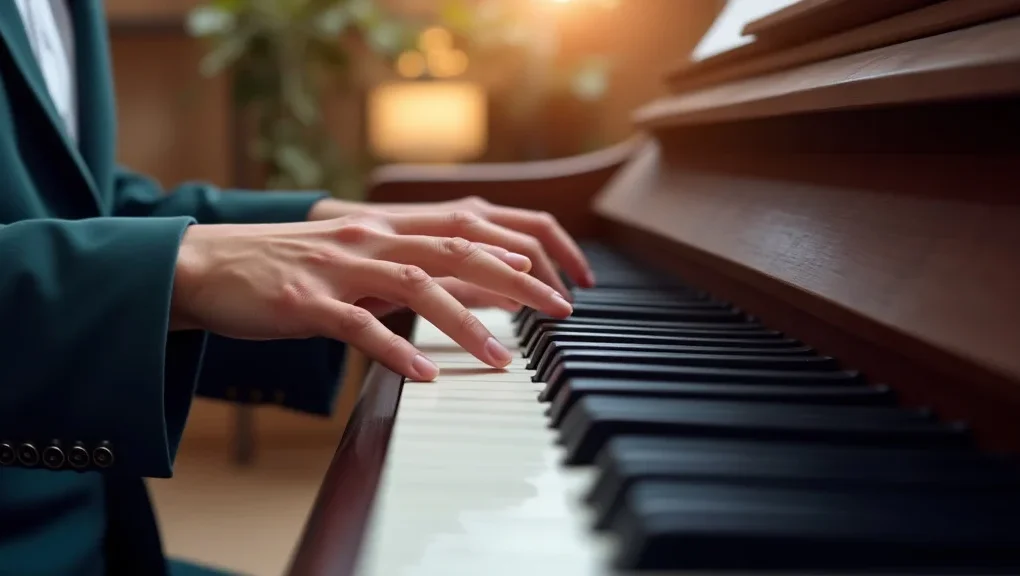
- Curved Fingers: Imagine you’re holding a small ball in each hand. Your fingers should be slightly curved, with the tips of your fingers poised to strike the keys.
- Wrist Flexibility: Keep your wrists relaxed and flexible. Avoid stiffening them. Use a slight up-and-down motion.
- Finger Exercises (Scales and Arpeggios): Practice scales and arpeggios daily to develop finger strength, coordination, and evenness. Start slowly and gradually increase the tempo.
This rounded position allows your fingers to hit the keys with more control. It also ensures that the weight of your arm can be transferred more efficiently into the keys.
Relaxation is key to efficient playing. It prevents tension and promotes a smoother playing technique.
These exercises will enhance your finger dexterity. They also serve as a foundational element of learning how to play the instrument.
Striking the Keys
How you strike the keys has a strong impact on your sound. Your touch should be firm but controlled. Varying your touch will let you express different emotions.
- Key Depth: Press the keys with a controlled touch. Avoid slamming the keys, which can lead to a harsh sound and potential injury.
- Arm Weight: Use the weight of your arm to create a rich tone. Let the weight of your arm gently fall into the keys, instead of solely relying on finger strength.
- Dynamics: Dynamics refer to the loudness or softness of the sound. Experiment with playing both loudly (forte) and softly (piano) to add expression to your music.
The depth you press the key determines how loud or soft the note is. Control your playing by controlling the key depth.
Using your arm weight lets you create a fuller sound. This also reduces strain on your fingers.
Dynamics are important for creating a musical feel. You will be able to play with more expression.
Effective Practice Strategies for Piano Beginners
Practice is the key to improving your skills. Practice should be regular and consistent. Developing a good routine will maximize your progress. Having an effective approach to your piano training for beginners will allow you to improve at a faster rate.
Setting Up a Practice Routine
A well-planned practice routine is very helpful for learning. Having a fixed schedule will help you to stick with it. Here are some of the keys to success:
- Consistency: Practice regularly, even if it’s just for a few minutes each day. Regular practice is much more effective than sporadic, longer sessions.
- Practice Duration: As a beginner, aim for shorter, focused practice sessions, such as 15 to 30 minutes per day. Increase the duration as your stamina improves.
- Structured Practice: Divide your practice time into sections, such as warm-up exercises, scales and arpeggios, learning new pieces, and reviewing old pieces.
Establishing a consistent practice schedule helps to build good habits and keeps your skills fresh. Make it part of your day.
Short, focused practice sessions prevent burnout and allow you to stay engaged. The key is to practice regularly.
A structured approach helps you to cover all the fundamental skills. This helps you to measure your improvements.
Effective Practice Techniques
Knowing how to practice can improve your ability. It is very important to do things the right way. Your practice time will be more productive. There are some important components.
- Slow Practice: Start practicing new pieces slowly, focusing on accuracy and evenness. Gradually increase the tempo as you become more comfortable.
- Divide and Conquer: Break down challenging sections into smaller parts and practice them separately. Once you master each part, combine them.
- Listen Critically: Record yourself playing and listen back to identify areas that need improvement. Pay attention to mistakes in rhythm, notes, and dynamics.
This helps you to learn the notes and rhythm correctly. Slow practice allows you to develop the muscle memory necessary for playing accurately.
This helps you to focus on specific areas that require improvement. It simplifies learning complex musical passages.
Self-assessment is a powerful tool. You can find problems you might not notice while playing.
Overcoming Challenges and Staying Motivated
Challenges are part of any learning process. Being able to continue will bring rewards. Here are some ideas:
- Dealing with Plateaus: It’s normal to experience plateaus. When this happens, change your practice routine, try new exercises, or work on different pieces.
- Finding Motivation: Set realistic goals, celebrate your achievements, and listen to music you enjoy. Playing with others or performing can also boost your motivation.
- Seeking Help: Consider taking lessons with a qualified piano teacher. They will provide personalized feedback, guidance, and help you correct any bad habits.
Don’t get discouraged. Plateaus are a natural part of learning. By changing your routine, you can break through those barriers.
Make it a fun experience. This will prevent you from giving up. Music should be fun.
A teacher can offer personalized support. They can identify problems and suggest solutions. This is the most effective way of improving.
Piano Training for Beginners: A Continuing Journey
Your piano training for beginners is the first step in a lifelong path. You’ve now established the foundation, and the experience will continue to enrich your life. As you progress, remember that music is about enjoyment and expression. Continue to explore and enjoy making music.
Frequently Asked Questions
Question: How often should I practice?
Answer: It’s best to practice regularly, even if it’s just for 15-30 minutes per day. Consistency is more important than long, infrequent sessions.
Question: What should I practice first as a beginner?
Answer: Start with basic exercises like finger exercises, scales, and simple songs. Focus on reading music and playing in time.
Question: How do I read sheet music?
Answer: Sheet music uses lines and spaces, with the clef indicating the note names. Note values determine how long to play each note. Practice will increase your understanding.
Question: What’s the best way to develop finger strength?
Answer: Practice scales, arpeggios, and finger exercises. Proper hand position and regular practice will build finger strength over time.
Question: How can I stay motivated while learning the piano?
Answer: Set realistic goals, celebrate your achievements, listen to music you enjoy, and consider taking lessons. Remember why you started and keep enjoying the process.
Final Thoughts
Beginning piano training for beginners is a significant undertaking, but this complete guide provides the knowledge and direction to start your musical adventure. This post will help you to choose your instrument, understand musical theory basics, and develop essential techniques. With a focus on rhythm and notes, you’ll be able to quickly gain an understanding of how to play. Remember, good posture, finger exercises, and striking the keys correctly are key elements of building a strong piano technique. The focus should be on creating a well-structured practice routine that lets you improve. Stay motivated by setting achievable goals and seeking help when you need it. Embrace the journey, and most importantly, enjoy the process of making music! With dedication and persistence, you can realize your musical aspirations. Continue to explore and experiment with the joy of playing.